
Engineering Services Menu


Heavy Haulage Electrification Options for Mines
Options for heavy haulage electrification at my mine
At first glance, electrifying heavy-haulage operations in mining appears to be a choice between means of electrification:
- Buying or converting to battery-electric (BEV)
- Converting to hybrid (diesel-electric) drives (PHEV)
- Shifting to electric-powered conveyances
- Adding trolley assist/down-haul recuperation
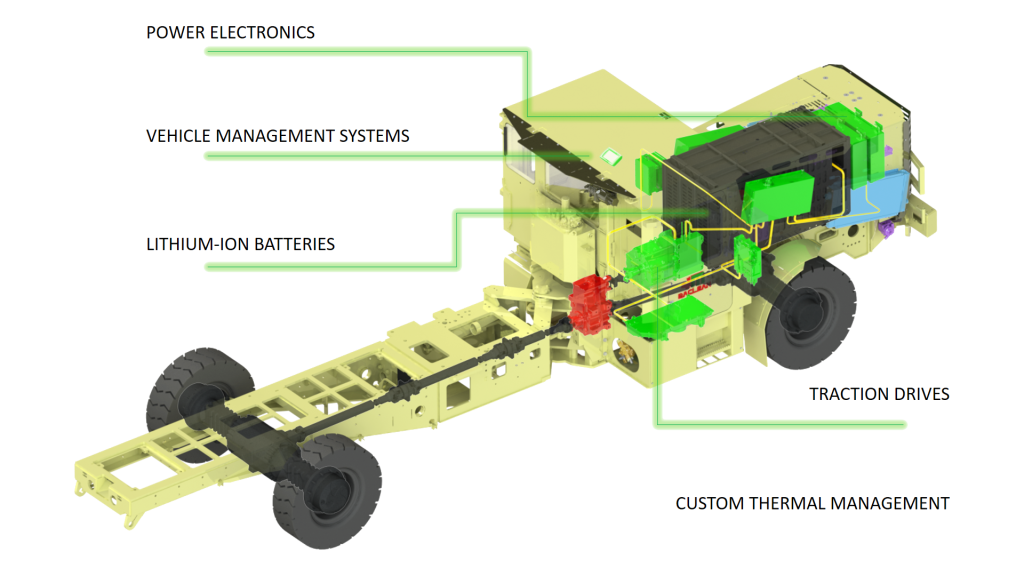
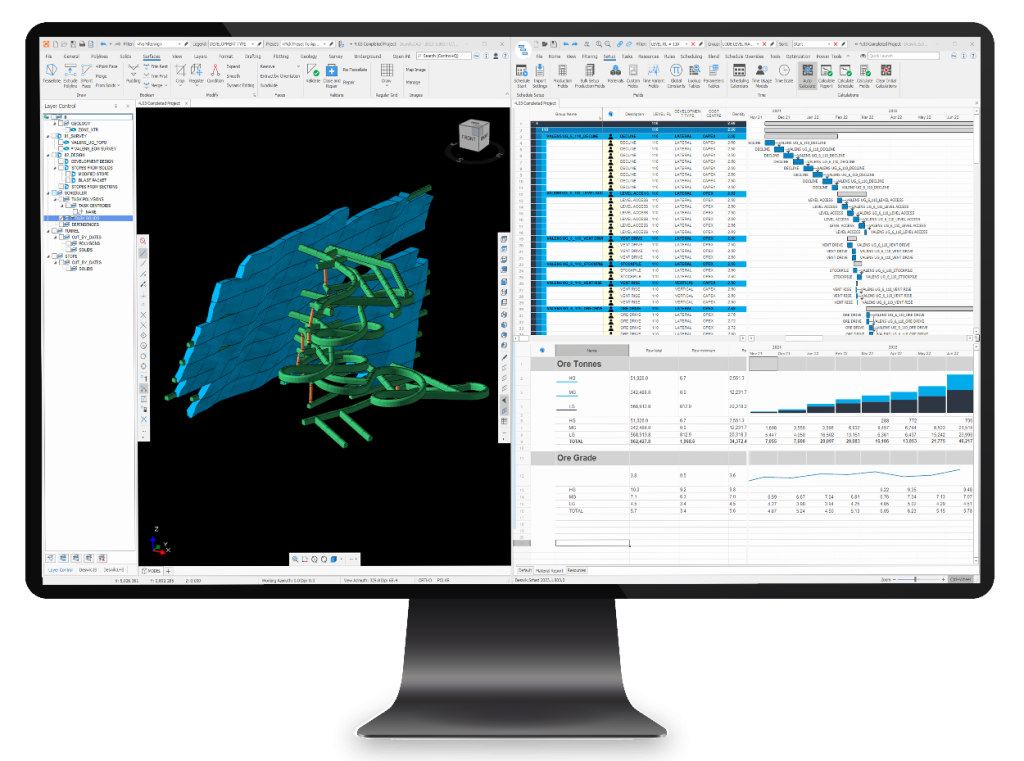
But the right haulage decisions are rooted in mine fundamentals: can your haul routes, grades, cycle times, infrastructure and energy supply support the switch to electric without sacrificing productivity or ballooning capital cost? Electrification comes with clear operational savings, but it can be capital-intensive.
Heavy-haulage vehicle electrification is not simply a fleet planning decision; it’s a whole-mine evolution. From choosing the right kind of vehicle electrification, to rethinking work and duty cycles, infrastructure modifications that reduce the extent of ventilation needed, and add charging and electricity supply infrastructure.
How to proceed will be different for every mine, but the answers must lead towards a favourable cost-per-tonne-mile equation. Studies show that electric fleets in underground mines benefit significantly from ventilation cost savings, while open-pit operations with their longer haul distances and high-payload trucks benefit greatly from reduced fuel costs. Both must navigate grid constraints and the need to deliver the right quantity and quality of electricity. Hybrid diesel-electric is emerging as an option for several reasons.
In practice, you will need to select the right architecture (battery-electric, tethered/trolley, hybrid), size the infrastructure (chargers, grid upgrades, microgrids, battery storage, local renewables-based generation), model cost-per-tonne-mile for the fleet (including charging, downtime, maintenance and ventilation)…and align this with your mine plan. A tall order!
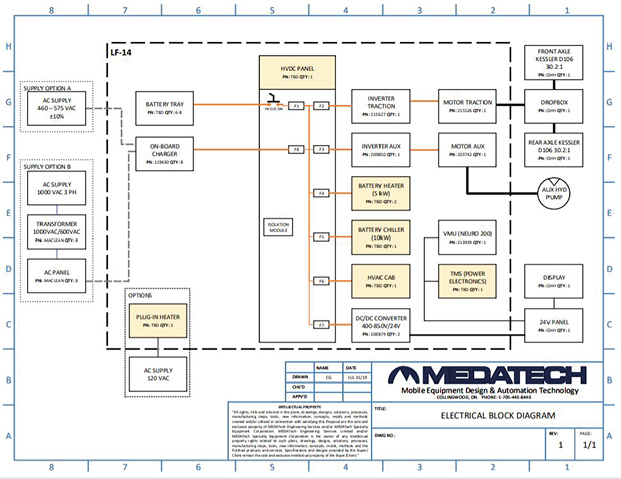
Companies like MEDATech Engineering provide modelling software to support these decisions, as well as the ability to electrify heavy-duty mobile equipment for its intended duty cycle.
Heavy-haulage electrification is both feasible and increasingly necessary—but the “how” depends heavily on your haul profile, infrastructure readiness, capital versus operating cost trade-offs, and whether you’re operating underground or on surface.
Here’s a more in-depth breakdown of the hurdles, strategies and options:
Challenges of Heavy-Haulage Electrification for Mines
1. Infrastructure and grid supply
Large haul trucks draw immense power. Peak charging can require double-digit megawatts. Upgrading the mine’s electrical infrastructure—including grid connection, transformers, chargers, microgrid, , power renewable power generation, as well as battery power storage, and/or generator backup—is a major CAPEX hurdle. According to an article by IEEE Power & Energy Society, mine sites are undergoing grid transformation because of increased electricity load, aging systems and the integration of DER (distributed energy resources) with vehicles and storage.
For open-pit operations in particular, switching dozens of heavy haul trucks to BEV or trolley assist could double or triple the site’s electricity demand as well as require very high peak power demands, according to DC-mobility transition assessments. In remote mine sites, or where the grid is weak, this becomes a gating factor that some mine sites are overcoming by means of diesel-electric hybridization.
2. Vehicle duty cycles, routes and haul characteristics
The duty cycle of haul trucks (payload, ramp grade, cycle length, ambient conditions) plays a central role in whether electrification, and what kind of electrification, makes sense. For underground mines, short cycles and high ventilation costs make conversion to electrified haul trucks more attractive. Mine layout may need modification, as BEV vehicles require spaces for charging or (much bigger) spaces for battery swapping.
For open pit mines, the first step is a review to evaluate the pit layout and mining sequence to see if trolley assist, BEV, diesel/electric hybrid or conveyor are feasible and whether viable workarounds are available.
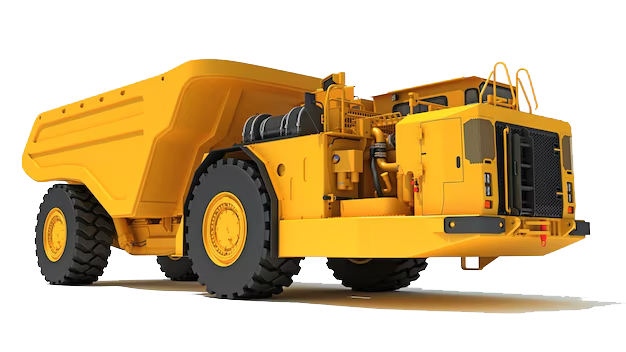
In the case of BEV haul trucks for open pit mines, longer distances and heavy payloads can mean vehicles with bigger battery banks and higher megawatt charging needs. This makes tethering more attractive. While a BEV CAT 777 may seem like a great idea at first blush, consider the double-digit megawatt power draw required to charge its massive, heavy battery within an acceptable time period.


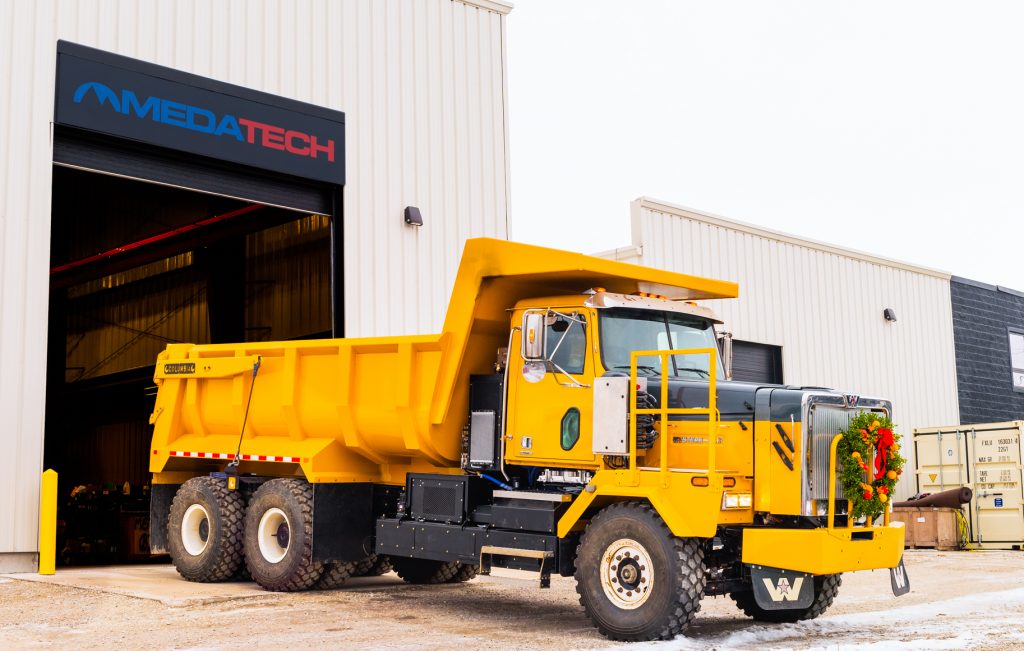
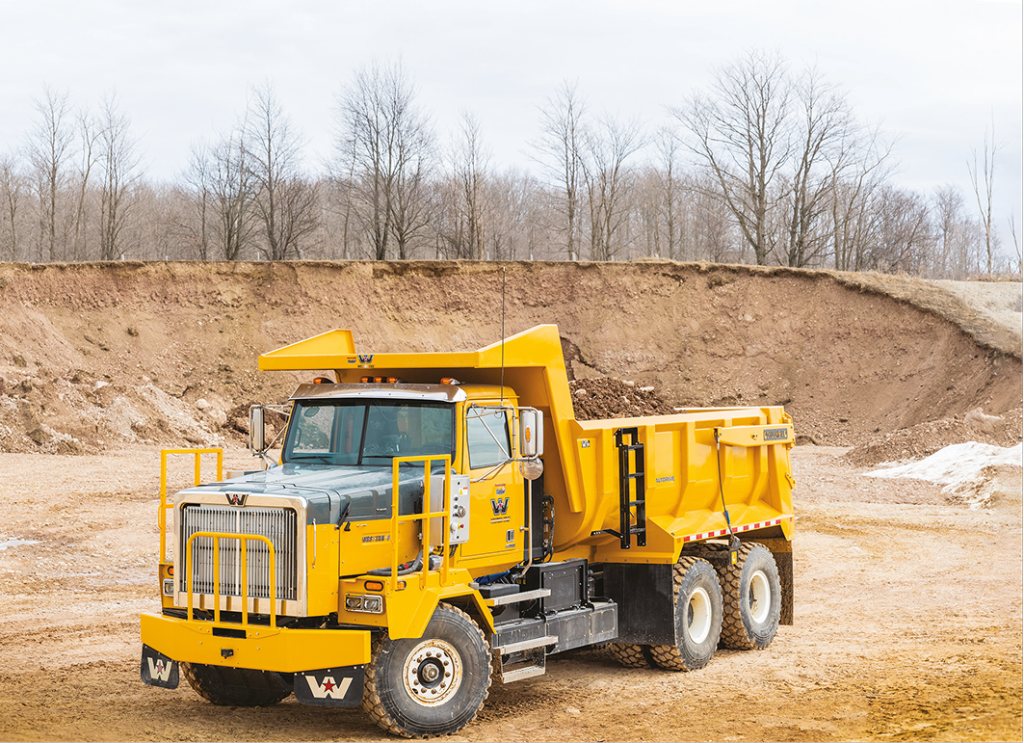
For every duty cycle, however, there are alternatives. Converting one CAT 777 to BEV incurs approximately the same capital cost as converting eight articulated heavy-haul trucks like the Western Star 4900. The eight-truck fleet will haul almost eight times as much material and require lower-megawatt power draws than the single CAT. Labour costs would increase, as would maintenance costs. There would be a need for more chargers, albeit lower-voltage chargers, and turnaround points might need to be rethought. But an eight-fold increase in productivity, and far lower peak power demands, could tip the balance in favour of the eight-truck fleet.
Consider also the same eight-truck fleet operating on hybrid diesel-electric power. No charging infrastructure is required. On the downhill leg of the haul route, trucks have their engines turned off and use regenerative braking to charge onboard batteries, which are ideally sized for the machine and its duty cycle. Battery power enables the trucks to operate while tramming on relatively flat ground as well as while loading and unloading. The diesel engine switches on automatically for the uphill haul, and can be supplemented by battery power, depending on the configuration of the hybrid. Depending on the duty cycle and vehicle configuration, fuel costs may be reduced by 15% to 30%, maintenance costs reduced, and ventilation costs may also be substantially reduced.
3. Productivity Impacts
Vehicle charging and battery swapping, if poorly planned, as well as infrastructure failures, can reduce truck availability and increase cycle times. This is an especially sensitive matter underground, because ventilation and ramp access are tied to cycle times. With electrified equipment it may make sense, for instance, to add one extra haul truck to the fleet in order to maintain cycle time. Shift start times might need to be staggered to accommodate charging schedules, or hybrid equipment may be selected for benefits like maintaining current cycle times and mine schedule.
Choice of electrification method can also impact cost, throwing the cost-per-tonne-mile equation off kilter. For instance, a study conducted by MEDATech for a mining customer found that battery-swapping yielded productivity similar to that of high-rate fast-charging but cost 48% to 65% more over five years. Any switch away from current methods must maintain or improve cost-per-tonne-mile value to be considered viable.

4. Underground Ventilation, Heat and Emissions
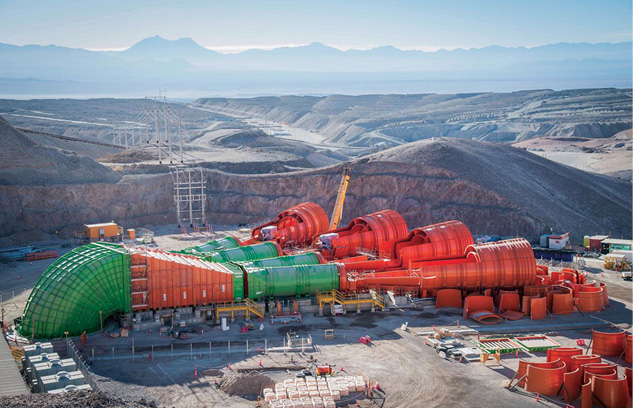
Diesel haul truck and loader emissions (NOx, CO2, CO, PM), as well as the heat the engines generate, need to be exhausted effectively from underground mines for miner health reasons. Massive ventilation is expensive to install and to run, so haul truck electrification can provide incidental cost savings through reduced need for ventilation (CapEx, new mines; OpEx, new and existing mines), although new albeit lower thermal loads will be generated by charging and auxiliary systems.
5. Capital cost, return on investment (ROI) and life-of-mine planning
Switching to electrified or hybrid equipment in an operating mine can make sense for some duty cycles. But since the capital costs of electrified equipment are high, it can be most advantageous to plan electrification for a new mine. The ROI will depend on savings in fuel/maintenance, ventilation, health & safety benefits, and regional CO₂/Scope 1 reduction incentives.
As an example, MEDATech’s BEV powertrain kits are sized for heavy-duty mobile equipment and reduce both fuel and maintenance costs. The same goes for our hybrid diesel/electric conversions. Over time, given the right use case, there is a strong ROI for both. But it’s all about the use case. If the remainder of mine life is short, production uncertain, or sufficient grid power unavailable, the business case for either BEV or hybrid vehicles may not stack up.
Strategy: Planning for Heavy-Haulage Electrification
1. Define your haulage profile and cost-per-tonne baseline
Start by assessing your current or planned diesel fleet: capital costs, fuel costs and maintenance costs, ventilation cost (underground), haul distances, ramp grades, payloads, cycle times and downtime. Use this as a baseline for cost-per-tonne-mile.
2. Use scenario modelling software
Next, model electrified alternatives (battery, trolley, hybrid) for the same haul distances, ramp grades and payloads. Include capital vehicle costs, electrical infrastructure costs, as well as ongoing energy costs, ventilation cost reductions, any applicable CO2 reduction savings, plus downtime risk and maintenance savings.
It goes without saying that all of this is not simple to model. There are companies that offer fleet modelling services; MEDATech is one such firm. For power infrastructure requirements, Stream Systems offers sophisticated modelling. Together, these kinds of modelling take into account all required simulation: the machines required, type of electrification and battery sizes, type and placement of charging infrastructure (if required), duty cycle, ventilation needs, shift modifications and other factors, resulting in a fairly accurate cost-per-tonne-mile over life of mine.
With such a model, you can change parameters to answer ‘what if’ scenarios. As examples, what if battery costs decline 20% over five years, what if grid power costs increase, what if power storage metrics improve 30%, what if diesel costs increase 25% over five years, or what if ramp grades change.
It is worth noting that run-of-mine electrification, or even a partial move to pure electric, may be too aggressive upfront. Hybrid diesel-electric trucks, tether-diesel-electric, or conveyor/rail systems may provide a logical ‘stepping stone’ approach to reduce the obvious downsides of internal combustion engines.

3. Select the transport scenario that makes most sense
With modelling complete, you will know what types or mix of transport to choose for lowest cost-per-tonne-mile:
- Battery-electric haul trucks (BEV) with fast-charging or battery-swap
- Trolley-assist haul trucks
- Hybrid diesel-electric haul trucks
- Charging infrastructure with opportunity charging or onboard charging
- Conveyors or in-pit crushing & conveying (IPCC) as an alternative to truck haulage
Financial profit may not be the only goal of electrification, but if the choices are clear from a financial perspective, it becomes easier to make decisions based on a variety of factors, including health & safety (exhaust gases, particulate, heat, noise & vibration, dust, risk of fire), CO₂/Scope 1 reductions, and corporate values more broadly speaking.
Below is a breakdown of options and how they apply differently in open-pit and underground mining.
3A- Underground mine haulage
Underground haulage offers some of the strongest cases for electrification—shorter cycles, high ventilation costs for diesel, and often ramp/tram routes more constrained.
Typical options and considerations:
- Battery-electric haul trucks (BEV): Underground cycles often allow moderate battery packs, making BEV an affordable and practical option.
- Fast-charging vs battery-swapping: A MEDATech study found that under certain conditions, fast charging (600 kW) out-performed battery swapping from a cost perspective in an underground mine setting.
- Example: For 5 trucks + 3 loaders, over 5 years, fast charging cost ~$1.01 M vs ~$2.49 M for similar productivity with battery swapping.
- Charging infrastructure: Underground charging zones need charging-bay ventilation and need to meet high-voltage system safety requirements. Note that shift scheduling may require changing to accommodate charging.
- Ventilation and heat loads: Electric trucks reduce diesel emissions and heat, allowing possible down-sizing of ventilation.
- Lifecycle planning: Underground mines often have longer ramp/tram distances, so planning for battery size, charging points along ramps, and decline regeneration becomes key.
- Hybrid diesel-electric haul trucks: Provide a means of reducing diesel consumption without adding electrical infrastructure or altering mine plan or shift schedule.
- Reduced diesel consumption may positively impact ventilation and heat loads
- Duty cycle and vehicle model should inform hybrid configuration in order to product the greatest savings for the least investment.
Best‐practice considerations
- Pilot a small fleet first, learn and scale
- Use fleet modelling software to optimize battery size, charging location (if applicable), trucks per shift, delivering an accurate cost-per-tonne-mile
- Consider total cost of electrification, including shift modifications and mine plan adjustments, in calculating BEV and hybrid benefits
- Align scheduling so that BEV charging occurs during operator breaks or in non-productive windows
- Use regeneration (down-haul) to recharge batteries
- Incorporate safety and ventilation planning (BEV charging bays generate heat, high voltage risk)
3B- Open-pit mine haulage
Open-pit haulage presents different challenges: long haul distances, ultra-class trucks (200-370 tonnes plus), high payloads, and more exposed infrastructure. But the decarbonisation pressure and productivity gains mean electrification options are progressing.
Typical options and considerations
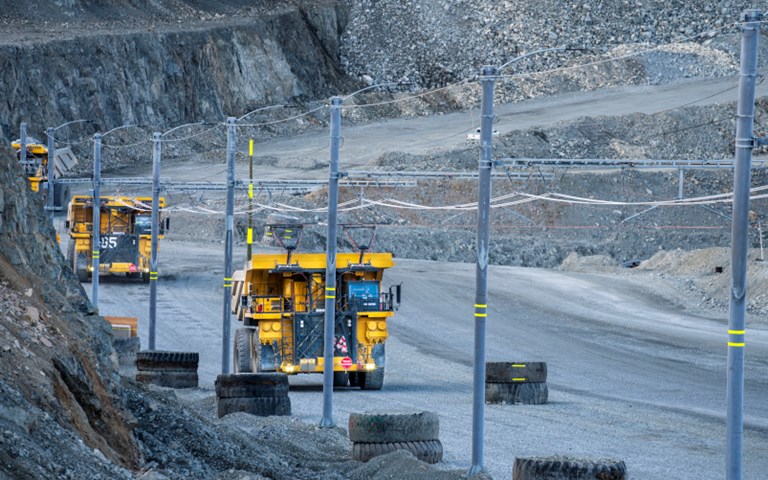
- Trolley-assist systems: Overhead catenary or trolley line on uphill segments where energy demand is highest. Trucks connect to the line via pantograph while loaded uphill and run diesel or battery downhill. This is proven technology in open-pit mining.
- Battery-electric haul trucks: For open-pit conditions, battery haul trucks require very large battery packs, high-power chargers or swap infrastructure. Distance constraints are also important.
As noted in a review of surface mine haulage, Battery Trolley (BT) systems (battery trucks plus overhead trolley plus energy recovery) are seen as a next-generation zero-emission option. - In-pit crushing & conveying (IPCC): As an alternative to truck haulage altogether, IPCC is a low-carbon shift to conveyors that reduces the truck fleet electrification burden, as trucks are not needed for long uphill hauls.
- Hybrid diesel-electric trucks: A logical step on the road to full electric conversion.
Best‐practice considerations
- Map haul ramp grades, distances, cycle times and evaluate where uphill trolley lines are best placed (dump-to-load and return)
- Conduct a full cost-per-tonne calculation comparing diesel baseline, trolley-assist, BEV and hybrid trucks. Take into account fuel, maintenance, electrical infrastructure and power cost, applicable CO₂/Scope 1 reduction incentives.
- Build in flexibility. For example, design a trolley-assist system that can transition to battery trucks with deck-top charging.
- Phased implementation. For example, start with a pilot trolley section, monitor productivity gains, then scale.
- Factor in infrastructure lifespan: ramp width, lane usage, haul road geology, mine sequence.
- Align energy supply: grid upgrade, possible renewable generation, power storage, microgrid control.
Comparison Matrix
| Option | Suitability | Key benefits | Key risks |
|---|---|---|---|
| Battery-electric haul truck (BEV) | Short haul routes, predictable cycles (ideal underground) | Zero diesel emissions, less ventilation, potential maintenance savings | Large battery packs, charging downtime, infrastructure cost |
| Trolley-assist haul truck | Long uphill hauls in open pit, stable haul routes | High speed uphill, fuel savings, smaller battery required | Fixed infrastructure, fewer route changes, CAPEX upfront |
| Battery-trolley (hybrid of battery + trolley) | Emerging option in large open pits | Zero-emission trucks, use trolley for uphill, batteries for down/horizontal | Technology still scaling, infrastructure cost |
| Battery swapping vs fast charging (underground) | Underground with defined truck cycles | Fast charging shown more cost effective in many cases underground | Fast charging requires higher-power chargers |
| In-pit crushing & conveying (IPCC) | Open pit where haul distances are long and haul truck cost is high | Reduces haul truck fleet altogether, lower emissions | High initial cost, less flexibility, mine plan must allow it |
In Conclusion
Heavy-Haulage Electrification must Align
Heavy-haulage electrification must align with mine fundamentals such as haul routes, grades, cycle times, and energy capacity. While electric and hybrid fleets can reduce operating costs through lower fuel and ventilation requirements, those gains depend on maintaining productivity and controlling capital investment.
Electrification affects more than the fleet. It influences duty cycles, power distribution, ventilation, and overall mine planning, with different implications for underground and surface operations. Achieving a favourable cost-per-tonne-mile outcome requires choosing the right vehicle architecture, scaling charging and electrical infrastructure correctly, and accounting for grid constraints.
Because every mine is different, successful electrification depends on mine-specific modelling and alignment with the mine plan. Done properly, it offers a practical path to lower costs and more resilient haulage operations.
Transitioning to a hybrid diesel-electric fleet does not entail the same degree of planning or mine modification. It does not require a significant increase in electricity and makes use of the fueling infrastructure already in place. While it is not a comprehensive solution for heavy haulage electrification, it does take a major step in the right direction. Done properly, moving to a hybrid fleet can achieve a positive cost-per-tonne-mile quickly, with a minimum of disruption.
If you wish to explore the right vehicle mix for your mine, MEDATech can help. Fleet feasibility consulting is one of our core strengths. Every solution starts with a conversation—let’s talk. Please submit the form below and we will be in touch shortly.